Some important decisions taken by MoD's Defence Acquisition Council on 7th November, 2016. Some major purchases were cleared. Will post an article regarding that soon. Stay tuned.
Saturday, 12 November 2016

Saturday, 5 November 2016
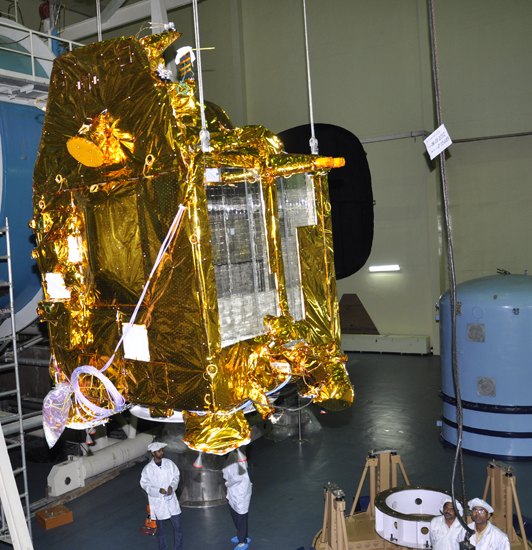
MARS ORBITER MISSION
Today is the third anniversary of the launch of ISRO's ""MARS ORBITER MISSION"" . Three years back MOM lifted off from Shriharikota onboard PSLV XL C-25.
The mission was a technology demonstrator, showcasing our capabilities of conducting an inter planetary mission. With the successful insertion in the martian orbit on 24th September, 2014 , India became the first nation to reach red planet in first attempt.
The mission life of the orbiter was six months but the precision insertion into the orbit saved a lot of fuel on the orbiter, which was used to extend the life of orbiter.
The mission is the best example of the capabilities of our space scientists. This mission was also the lowest cost mission to the red planet costing only INR 450 crores.
Image Courtesy : ISRO
""JAI HIND""


Saturday, 22 October 2016
PRIDE OF INDIA
8 years ago, ISRO made history. Chandrayaan-1, India's first mission to moon, was launched successfully from Sriharikota on 22nd October, 2008. The spacecraft weighing 1380kg's was launched using highly dependable PSLV C-11 rocket, which took off from the second launch pad, SHAR at 06:22 IST.
The spacecraft entered the lunar orbit on 8th November, 2008 and worked normally for 312 days from launch. The major achievement of the mission was the discovery of widespread presence of water molecules in the lunar soil. The mission also included the Moon Impact Probe which struck the south pole of moon in a controlled manner making India the fourth country to have its flag on moon.
The mission was the breakthrough in India's space programme. The mission is a perfect example of the capabilities of the space scientists that our country is blessed with. Though the funds provided were not very high and the technological help from other nations was also limited, still we were able to reach the moon in our first attempt.
""JAI HIND""
Image courtesy : ISRO


Friday, 21 October 2016


Saturday, 15 October 2016
MISSILE MAN OF INDIA
The man who needs no introduction. My inspiration and of millions of others. Wish you a very happy birthday. We will always try to make INDIA of your dreams. Miss you sir.


Sunday, 25 September 2016
FINALLY
FINALLY, the wait is over.....
The wait for a medium range multi-role combat aircraft(MMRCA) for the IAF is over with the signing of the deal worth 7.8 billion euros for 36 RAFAEL aircraft. IAF will be acquiring a new combat aircraft nearly after 2 decades. The last being the big daddy of IAF, SUKHOI-30 MKI. This deal will add some strength to the ageing fleet of IAF, which still operates MIG-21's in vast numbers. Huge number of crashes in MIG-21's have earned it the tag of "flying coffin". Though outdated, MIG-21 was an awesome aircraft in its time.
In a govt-to-govt deal, France will supply 36 fighter jets in flyaway condition to India. The first jet will be coming in September, 2019 and the last one probably in August, 2022. The cost of the jets is 3.4 billion euro and the rest 4.4 billion euro being for spares, maintenance, logistics, weapons, training and alternations demanded by India.
Dassault emerged as the lowest bidder in the original MMRCA programme, which saw 6 participants and Eurofighter Typhoon and Dassault Rafael making it to the last stage. Both the fighter jets went to the last round after a series of flight trials in harsh conditions. Tests were carried out at Bangalore for its humid climate, in Jaisalmer for its extremely hot climate and in Leh for its extremely cold conditions. The other 4 participants in the race were Lockheed Martin F-16IN super viper, Boeing's F-18 super hornet, Gripen from SAAB and MIG-35 from Russia.
The original MMRCA was for procuring 126 aircraft, 18 in flyaway condition and the rest 108 had to be made in India by Hindustan Aeronautics Limited(HAL) with the help of transfer of technology(TOT). But the current NDA govt. scrapped the original programme and rather went for a govt-to-govt deal to buy 36 aircraft off the shelf directly in flyaway condition, with a clause for a possible follow on order of another 18. Sources believe that the govt. will soon roll-out MMRCA-2 to obtain more jets of the same category.
Pic credits:- respective owners


Sunday, 18 September 2016
PROJECT 15B
"INS MORMUGAO" launched yesterday is the second warship being built under the "PROJECT 15B" (Visakhapatnam Class Destroyer) at Mazagaon Dockyard, Mumbai. This project worth about 30, 000 crore rupees, is a follow-on order of successful "PROJECT 15" (Delhi Class Destroyer) and "PROJECT 15A" (Kolkata Class Destroyer).
The Visakhapatnam Class is a class of 4 stealth guided missile destroyers currently under construction. The project is based on Kolkata class design and incorporates many improvements in it. The first ship under the project(INS VISAKHAPATNAM) was launched last year and is expected to get commissioned in 2018.
Having a displacement of 7400 tonnes, the ship is 163 m long and 17.4 m wide at beam. It has a speed in excess of 30 knots and has a range of 4000 nautical miles. The ship has a crew of 300 which includes 50 officers and 250 sailors. The ship is propelled by gas and diesel turbines which have been built by Ukraine.
The Made in Israel Multi Function Surveillance Threat Alert Radar (MF-STAR) is the main radar of the warships.Stealth features of this ship will be better than its predecessors as the shape of the hull and radar transparent deck fittings will make it difficult to be detected by enemy radars.
The ship is armed with 32 Barak surface to air missiles(SAM) and 16 Brahmos cruise missiles. It has a 127 mm main gun and AK-630 close in weapon system(CIWS) as anti submarine warfare. Besides these, it also has 4 torpedo tubes and anti submarine rocket launchers. The ship will also have a hangar for 2 Sea-king, Chetak or HAL Dhruv helicoters.
The ships once commissioned will be a great addition to the capabilities of the Indian Navy and its goal of becoming a blue water navy.


Saturday, 17 September 2016
KEEP CALM AND BELIEVE IN ISRO
ISRO does it again.....!!!!
On 8th September 16:50 hrs IST, GSLV-F05 lifted off from the second launch pad of Sriharikota to launch INSAT-3DR weighing 2211 kg to GTO(Geostationary Transfer Orbit). The satellite was injected into the orbit after a flight lasting 1024 seconds approx. This satellite was the heaviest ever launched by ISRO. The launch was a significant one as it was the first operational launch of GSLV, which uses indigenously developed CUS(Cryogenic Upper Stage).
Just for readers information, CUS is a very complex technology and only 5 countries other than India possess this. The complexity of this stage can be understood by the fact that liquid oxygen(-183 deg Celcius) as an oxidizer and liquid hydrogen(-253 deg Celcius) are used in this technology. CUS produces more thrust for every gram of fuel burned as compared to solid and earth-storable propellants.
Coming to the satellite, it is an advanced weather satellite carrying 4 payloads namely Imager, Sounder, Data Relay Transponder (DTR) and Satellite Aided Search and Rescue Transponder (SAS & R). Expected mission life of the satellite is 10 years.
Here are some majestic clicks from the launch.
PIC Credits - ISRO


Subscribe to:
Posts (Atom)